

A Homeowner’s Guide to the Parts of a Rain Gutter System
Knowing what makes up your home's gutter system is the first step toward preventing some serious water damage. Think of it as a connected network where every single piece, from the gutters that catch the rain to the downspouts that guide it away, has a vital job to do in protecting your foundation. A properly functioning system is essential for homeowners everywhere, from Salt Lake City to Provo.
Your Quick Guide to Gutter System Components
A gutter system that actually works is non-negotiable for any home, especially in Utah. The regional weather can include heavy snow, sudden spring thaws, and intense summer storms. Every part has to pull its weight to manage all that water and keep your property safe. A well-maintained system is the best defense against a wet basement and eroded soil around your foundation.
This diagram shows the basic journey water takes from your roof to the ground.
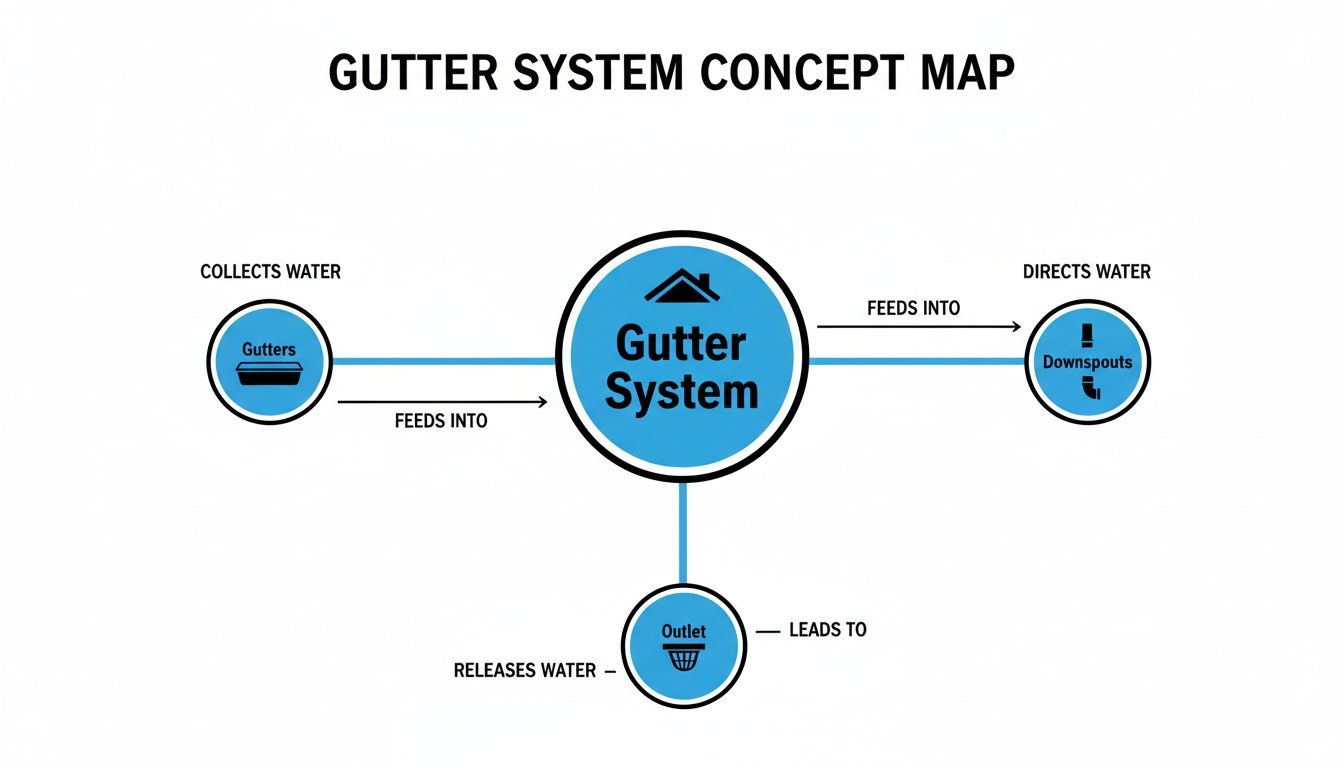
It gives you a great visual of how water flows from the horizontal gutters, into the outlet, and down through the pipes.
To help you get familiar with the terminology, here’s a quick-reference table outlining the key parts covered in this guide.
Rain Gutter System Components at a Glance
| Gutter Profiles | The main channels that collect rainwater from the roof. | Section 1 |
|---|---|---|
| Hangers/Brackets | Fasten the gutters securely to the fascia board. | Section 2 |
| End Caps | Seal the ends of the gutter runs to prevent water from spilling out. | Section 3 |
| Miters (Corners) | Join gutter sections together at roof corners. | Section 4 |
| Outlets (Drops) | Connect gutters to the downspouts, allowing water to exit. | Section 5 |
| Downspouts | The vertical pipes that carry water from the gutters to the ground. | Section 6 |
| Elbows | Bends in the downspout used to navigate around eaves and walls. | Section 7 |
| Downspout Extensions | Extend the downspout to direct water further away from the foundation. | Section 8 |
| Leaf Guards | Covers that prevent leaves and debris from clogging the system. | Section 9 |
| Splash Blocks | Placed under the downspout to prevent soil erosion from water outflow. | Section 10 |
| Fascia & Soffit | The boards your gutter system is attached to, providing structural support. | Section 11 |
This table is a cheat sheet, but we'll dive deep into what each of these parts does, what to look for, and how to maintain them in the sections below.
Section 1: Gutter Profiles (The Troughs)
The system starts with the gutters themselves—the long, horizontal troughs mounted right along your roofline. In the U.S., aluminum is a leading gutter material, holding significant market share because it's lightweight, rust-proof, and durable. You can learn more about the growth of the rain gutter market and why these material choices matter.
For homeowners in places like Orem and Lehi, where a fair share of precipitation is common, seamless gutters are often a preferred solution. Because they're custom-made for a home without any joints or seams, seamless systems can significantly slash the risk of clogs when compared to traditional sectional gutters. Fewer seams mean fewer places for leaves and gunk to get snagged.
Understanding Gutter Sections and Profiles
Think of the long, horizontal channels running along the edge of your roof—those are the gutter sections, or troughs. They are the workhorses of your entire drainage system. Their one critical job is to catch all the rainwater sheeting off your roof and guide it safely away from your home's foundation, siding, and windows. If these sections fail, the whole system fails.
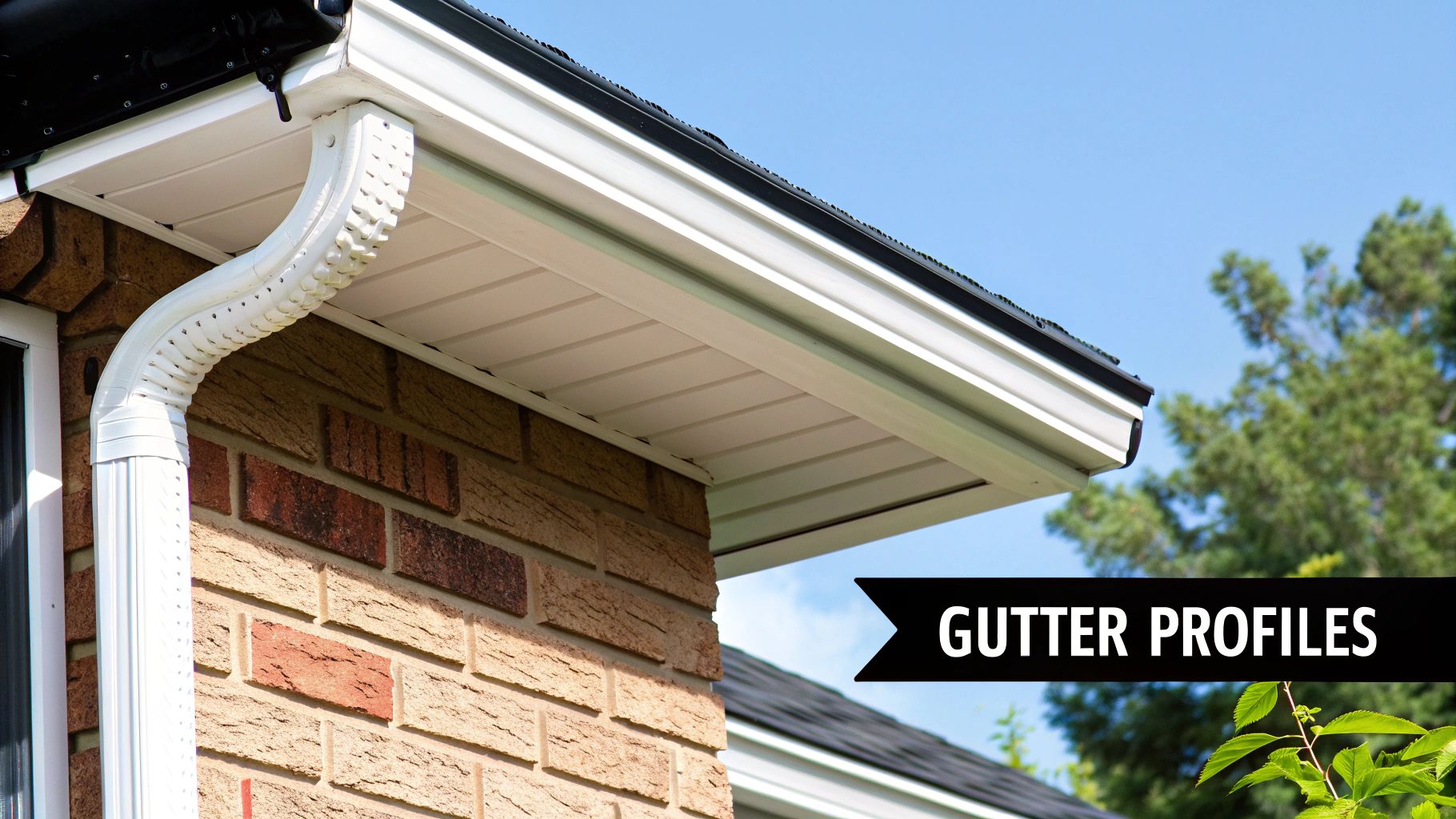
You'll generally find gutters in two main configurations: sectional and seamless. Sectional gutters are what you might pick up at a big-box store—they come in pre-cut lengths that are pieced together. The problem? Every connection point, or seam, is a potential point of failure where leaks can develop over time.
Seamless gutters, on the other hand, are the modern standard for a reason. These can be custom-formed on-site from a single, continuous piece of metal to perfectly match the dimensions of a home, whether it's in Salt Lake City or a neighboring community. No seams means no weak points, which significantly cuts down the risk of leaks. You can dive deeper into the benefits in our guide on seamless gutters vs. regular gutters.
Gutter Profiles and Materials
It's not just about being seamless; the shape, or profile, of the gutter matters, too. The two you’ll see most often are K-style and half-round.
- K-Style Gutters: These are, by far, the most common profile you'll find on homes today. They feature a flat back that sits flush against the fascia and a decorative front that often resembles interior crown molding. This design isn't just for looks—it also allows K-style gutters to hold more water than a half-round gutter of the same width.
- Half-Round Gutters: With their classic, semi-circular shape, half-round gutters lend a more traditional or historic look to a home. While beautiful, they carry a bit less water and can be more susceptible to overflowing in a heavy downpour if not sized correctly.
The material your gutters are made from is just as important, especially given Utah's weather swings. For homeowners from Provo to West Jordan, aluminum is almost always a reliable bet. It’s lightweight, won't rust, and holds up incredibly well for decades. You'll see other materials out there, like vinyl, which can become brittle and crack in cold winters, or steel, which is strong but will rust if the finish gets scratched.
Of course, these sections don't just float in mid-air. They're held up by hangers and closed off with end caps, which we'll get into next.
The Unsung Heroes: Downspouts and Outlets
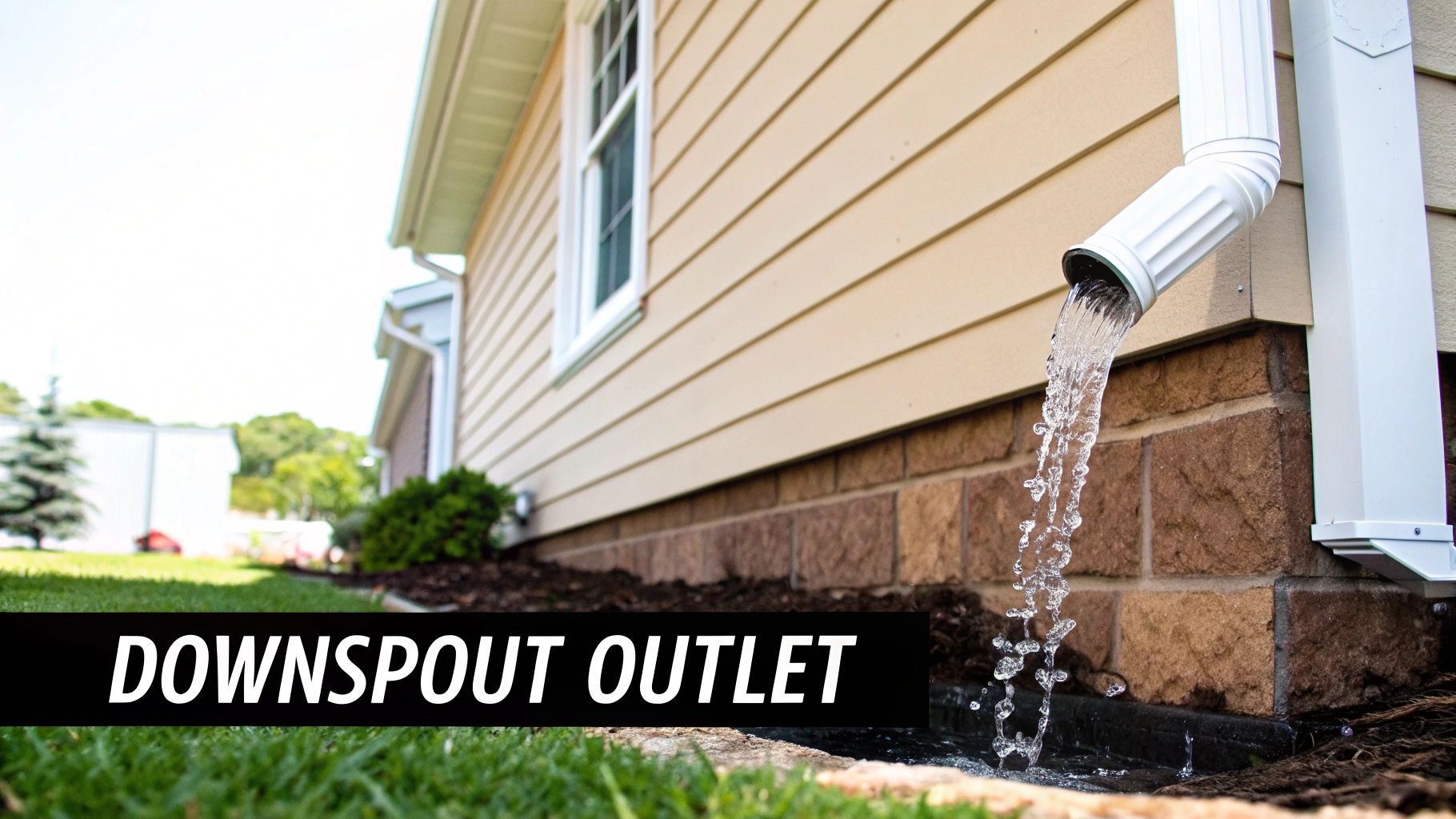
Think of your gutters as the collectors, but it’s the downspouts and outlets that do the heavy lifting of getting all that water safely away from your house. The outlet is simply a carefully placed hole in the bottom of your gutter. It's designed to funnel all the collected water into the downspout, which is the vertical pipe you see running down the side of your home.
This duo is arguably one of the most vital parts of a rain gutter system, channeling thousands of gallons of water away from your foundation every single year.
It's easy to underestimate their importance, but a single Utah storm can drop a staggering amount of water onto your roof. Properly sized downspouts are the only thing preventing that water from causing serious damage. In fact, some studies suggest that a significant percentage of basement floods can be linked directly to downspouts that are clogged or not working correctly. You can discover more rain gutter insights to see just how critical these components are.
Getting the Size and Placement Just Right
Downspout sizing and placement aren't a guessing game; they're crucial for the system to work. The right setup depends on factors like your roof's total square footage and the typical intensity of rainfall in your area. For homeowners in places like Lehi, where weather can range from a light sprinkle to a heavy downpour, getting this right prevents overflows that soak your siding and destroy landscaping.
A good rule of thumb is to have one downspout for every 20 to 40 linear feet of gutter. But the only way to be certain a system can handle the water volume a specific roof will generate is with a professional assessment.
Warning Signs of Downspout and Outlet Failure
You need to keep an eye out for the tell-tale signs that these essential parts of a rain gutter system are in trouble.
- Visible Clogs: This is the most obvious one. If you can see leaves, twigs, or other gunk poking out of the top or bottom of the downspout, you have a blockage.
- Water Stains on Siding: See those ugly streaks running down your siding right below the gutter? That's a clear sign water is overflowing instead of going down the spout.
- Puddles at the Foundation: If water is pooling around the base of your house after a storm, your downspouts aren't directing it far enough away. This is a major red flag for potential foundation damage.
- Sagging Gutters: A clogged outlet causes water to back up and sit in the gutter. That water is heavy, and its weight can cause the gutter itself to sag and pull away from the fascia.
Spotting any of these issues means it's time to take action before a small problem becomes a huge one. A professional service call from a team like Prime Gutterworks can clear those blockages and get your system ready for whatever the next storm throws at it.
How Hangers and Fascia Hold It All Together
Think of your gutter system like a chain—it's only as strong as its weakest link. In this case, the foundational support comes from the fascia and the hangers. The fascia is that long, straight board running right along the edge of your roof. Just beneath it, you'll find the soffit, which is the finished underside of your roof's overhang. Together, they create the mounting surface for your gutters and protect your home's rafters from the weather.
The gutters themselves are fastened to the fascia with special pieces of hardware called hangers or brackets. Getting this part right is absolutely critical. Even the highest quality seamless gutters will sag, pull away, or fail completely if the hangers aren't installed correctly and securely anchored. A professional installation focuses on spacing them properly to handle the weight of heavy rain, snow, and even ice.
Choosing the Right Hanger Matters
You might not think much about hangers, but the type used makes a big difference in both the system's strength and how it looks.
- Hidden Hangers: These are commonly used in modern installations. They clip inside the gutter trough and are screwed directly into the fascia board, making them invisible from the ground. This gives you a clean, sleek look without sacrificing an ounce of strength.
- Spikes and Ferrules: This is an older, more traditional method. It uses a long spike hammered through the front of the gutter, through a metal tube (the ferrule), and into the fascia. The problem is that seasonal expansion and contraction can cause these spikes to work themselves loose over time, leading to sagging gutters.
Proper spacing is the key to longevity, especially with Utah's demanding weather. Hangers are typically placed every 24 to 36 inches to ensure your gutters can take a beating. A professional will also meticulously set a slight slope during installation, which is crucial for guiding water toward the downspouts instead of letting it sit stagnant.
One of the most obvious red flags of a failing support system is a visible gap between the back of the gutter and the fascia. When gutters pull away like this, water can get behind them, rotting out the fascia and soffit. This small problem can quickly turn into a major structural repair.
If you notice water stains on your fascia or see your gutters sagging, it’s a sure sign the support system needs immediate attention. The Prime Gutterworks team, serving homeowners in areas like West Jordan, can inspect your fascia's condition and make sure your gutters are properly anchored to protect your home.
Sealing the Deal: How Gutters Connect and Turn Corners
It’s often the smallest, most unassuming parts of a gutter system that make or break its performance. While the long stretches of gutter do the obvious work, it’s the connectors and corner pieces—the end caps and miters—that truly test a system’s ability to prevent leaks. These joints are the weak points, especially on older, pieced-together sectional gutters.
An end cap is exactly what it sounds like: a flat piece of metal or vinyl that seals off the end of a gutter run. Its job is simple but absolutely essential. It dams the water, preventing it from just pouring out the side and forcing it to flow toward the downspout where it belongs. A missing or poorly sealed end cap can let water cascade down your fascia boards and pool against your foundation, which is a recipe for rot and water damage.
Making the Turn: A Look at Miters
So, how does a gutter system navigate a corner? That’s where a miter comes in. A miter is a specially formed corner piece that connects two gutter sections, typically at a 90-degree or 45-degree angle, to create one continuous, water-tight channel around the bends of your roofline.
You'll generally run into two types of miters:
- Strip Miters: Think of these as a simple patch. They are small, flexible strips of material that cover the seam where two gutters meet at a corner, held in place with sealant.
- Box Miters: These are more robust, pre-fabricated corner pieces that fit over the outside of the gutter sections. They are widely considered the stronger, more durable option.
Getting a perfect seal at these mitered joints is non-negotiable. The sealant is constantly exposed to the elements, and over time it will inevitably crack, shrink, or pull away, creating a prime spot for leaks. This is a huge reason why modern seamless systems are so popular—they eliminate most of these vulnerable connection points from the start. A professional gutter installation focuses on minimizing these joints to ensure your home has the best possible long-term protection.
Getting Water Where It Needs to Go: Elbows and Extensions
Getting water down from the roof is just the first step. The real goal is to move all that water far away from your home's foundation, and that's where elbows and extensions come in. Think of these as the final, critical pieces of the puzzle that protect your home from long-term water damage.
Elbows are those angled connectors that you see near the top and bottom of a downspout. They’re the "joints" of the system, allowing the vertical downspout to hug the side of your house neatly, navigating around things like eaves, decorative ledges, and brickwork. Without them, you’d have a pipe sticking straight out—not very effective or attractive.
Why Extensions Are Non-Negotiable
Once the downspout brings water to ground level, a downspout extension takes over. This is the horizontal piece that attaches to the final elbow and directs water at least three to five feet away from your home. This might seem like a small detail, but skipping it is a recipe for disaster. When water dumps right at the base of your house, it leads to serious problems:
- Foundation Damage: Water pools against your foundation, where it can saturate the soil, create immense pressure, and eventually seep through cracks, leading to a wet basement or a compromised foundation.
- Soil Erosion: The constant flow of water will wash away the soil supporting your foundation, creating instability over time.
- Ruined Landscaping: A concentrated torrent of water can easily destroy flower beds, wash away mulch, and carve ugly trenches through your lawn.
Ensuring your extensions are properly installed and directing water to a safe drainage area is crucial. The team at Prime Gutterworks can assess your property's specific layout and grading to recommend the perfect setup. Whether you're in Provo or dealing with the diverse landscapes around Salt Lake City, a well-planned drainage system is your best defense against water damage.
Gutter Guards and Splash Blocks: Your First Line of Defense
Once your core gutter system is in place, a few key accessories can make a world of difference, saving you time on maintenance and protecting your home from water damage. Think of these as upgrades that boost your system's performance.
First up are gutter guards, sometimes called leaf filters or gutter screens. These are essentially covers that sit on top of your gutter channels. Their job is simple but crucial: let the rain in, but keep leaves, pine needles, and other gunk out.
If a home is surrounded by trees—a common sight in the Salt Lake City area—gutter guards can be a game-changer. Investing in a good system can help homeowners avoid the seasonal chore of climbing a ladder to scoop out clogs.
Different Guards for Different Needs
Gutter protection isn't a one-size-fits-all product. The best choice for a home depends on the type of trees nearby and other factors.
- Mesh Screens: These are a popular, straightforward option. They're typically made of metal or plastic and act as a simple grid to block larger leaves and twigs.
- Solid Covers: Also known as reverse-curve guards, these clever designs rely on surface tension. Water clings to the curved surface and flows into the gutter, while debris just slides right off the edge.
- Micro-Mesh Filters: This is a top-tier solution. The mesh is incredibly fine, capable of blocking everything from pine needles to tiny shingle grit, offering the most complete protection.
The technology has come a long way. The best micro-mesh systems can prevent a very high percentage of blockages. Considering that neglected gutters contribute to billions in home damage each year, installing a system that can significantly reduce cleaning frequency is a smart move. You can read more industry research on gutter protection systems to see the data for yourself. Prime Gutterworks installs advanced gutter guards and filter systems chosen to handle the types of foliage common in Utah.
Finally, don't overlook the humble splash block. This is just a small, sloped block—usually made of concrete or plastic—that you place on the ground right where your downspout ends.
It has one job: to break the force of the water gushing out of the downspout. Without it, that concentrated stream can carve out a channel in your landscaping, wash away mulch, and even erode the soil right next to your foundation. It's a simple, effective part that prevents a lot of headaches.
Common Questions About Rain Gutter Parts
When it comes to your home's water management, it's natural to have questions. This section tackles some of the most common things homeowners ask about the parts that make up their gutter system. Think of it as a quick reference to help you understand what's going on up there and when it might be time to bring in a professional.
What's the Most Important Part of a Rain Gutter System?
That’s a tough one, because every piece has a job to do. But if one had to choose, the seamless gutter sections and the downspouts are the two MVPs. The gutters are the front line—they have to catch every drop of water coming off your roof. The downspouts then have the crucial task of getting all that water away from your house.
If either one fails, the whole system breaks down. A clogged downspout or a sagging gutter section can lead to serious trouble for your foundation, siding, and landscaping. This is why a professional installation, like those done for homes in Salt Lake City, is so critical—it ensures both are perfectly matched to a home's specific needs.
Which Gutter Material Is Best for a Utah Home?
In Utah, the weather can be demanding. There is heavy snow, intense sun, and sudden, powerful storms. For those conditions, aluminum is a practical and popular choice. It's rust-proof, surprisingly lightweight, and can handle a heavy snow load without buckling—if it's installed with the right hangers and supports.
Seamless aluminum gutters, in particular, are often recommended. They offer a great mix of performance and value for local homes, whether they are in Provo or up in Orem.
One of the biggest pluses for seamless aluminum is how it handles our temperature swings. It can expand and contract without cracking or pulling apart at the joints, which is a major failure point you see all the time with older, sectional systems.
Can I Replace Just One Part of My Gutter System?
Absolutely. It's often possible to replace a single problem piece, like a leaking corner miter, a dented downspout, or one damaged section of gutter. As long as a compatible part can be found to fit with the existing setup, a spot repair can work just fine.
But here’s the thing: if you're seeing widespread issues like rust everywhere, multiple cracks, or sagging along several sections, you may be better off replacing the whole system. Patching it piece by piece could just end up costing you more in the long run. A quick professional inspection, which is available to homeowners in communities like West Jordan, can help you figure out which path makes more sense for your home.
If you've got more questions or just want an expert to take a look at your system, the team at Prime Gutterworks is always ready to help. Get in touch for a free, no-obligation estimate to make sure your home is protected. Visit us at https://primegutterworks.com to get started.